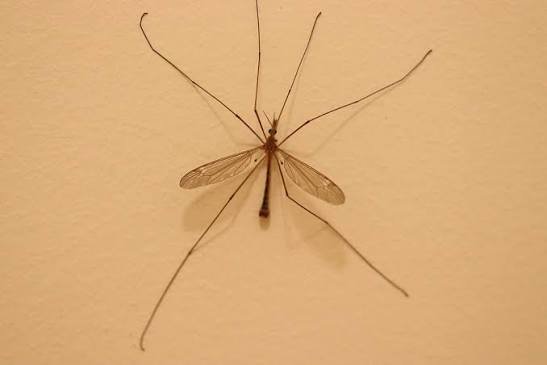

A long-legged insect appears near a porch light, window, or garden, moving awkwardly through the air. To many people, it looks like an oversized mosquito—and its common name seems to confirm the suspicion: “mosquito eater.” But the name is misleading. The insect most commonly called a mosquito eater is a crane fly, and despite its reputation, it generally does not hunt or consume mosquitoes.
This misunderstanding matters because people often confuse crane flies with mosquitoes, blame them for damage they didn’t cause, or treat them as natural mosquito-control agents, even though their biology tells a very different story.
What Is a Mosquito Eater?
The term “mosquito eater” is commonly used for crane flies, particularly members of the family Tipulidae. They belong to the order Diptera, the same broad insect order that includes mosquitoes, houseflies, and many other true flies.
Crane flies are easily recognizable for their extremely long, delicate legs and slender bodies. They can look like giant mosquitoes, especially when they fly around windows, lights, gardens, and other outdoor areas.
However, the resemblance is largely superficial.
Mosquitoes have specialized mouthparts adapted for piercing, and many female species use them to obtain blood meals. Crane flies lack the same feeding adaptations. Adult crane flies generally feed on nectar or other liquids when they do feed, while some species have such short adult lives that feeding is limited.
That distinction is at the center of the mosquito-eater misconception.
Why Are Crane Flies Called “Mosquito Eaters”?
The nickname has stuck because it seems intuitive.
Crane flies are considerably larger than mosquitoes, have similar-looking bodies, and often appear during periods when mosquitoes are also abundant. Their unusual flight can give the impression that they are actively pursuing smaller insects.
But appearance and timing are not evidence of predation.
The crane fly, commonly called a mosquito eater, does not normally eat mosquitoes. Adult crane flies are generally harmless to people and, in many species, may consume very little food or none at all.
Other regional names, including “mosquito hawk” and “skeeter eater,” have reinforced the same idea.
A Common Identification Mistake
The confusion is understandable when someone encounters a crane fly for the first time.
A typical adult may have:
- A long, narrow body
- Extremely long and fragile legs
- Two wings
- A mosquito-like silhouette
- Slow or awkward flight
- A tendency to appear around buildings and vegetation
Despite those similarities, crane flies are not simply enormous mosquitoes.
They also cannot bite humans in the same way mosquitoes do. Their anatomy isn’t adapted for taking blood meals, and their long legs are mainly for movement and positioning rather than attacking prey.
The Life Cycle of a Crane Fly
Understanding the crane fly’s life cycle helps explain why the adult insect and its larvae can have very different ecological roles.
The basic development follows four stages:
- Egg
- Larva
- Pupa
- Adult
Female crane flies generally deposit eggs in moist soil or other suitable environments. After hatching, the larvae—often called leatherjackets—develop in soil or other habitats depending on the species.
The larval stage can last much longer than the adult stage.
Eventually, the larva develops into a pupa before emerging as the familiar long-legged adult. The adult stage is mainly for reproduction, and in many species, it is relatively short.
Some crane flies survive as adults for only a few days or weeks, depending on the species and environmental conditions.
This short adult existence is another reason the image of an active mosquito-hunting insect does not fit the biology of most crane flies.
What Do Mosquito Eaters Actually Eat?
The answer depends heavily on the species and life stage.
Adult Crane Flies
Many adult crane flies consume little or nothing. When they do feed, nectar, plant fluids, or other liquids can provide nourishment.
This differs from the popular image of an adult insect flying through the air and catching mosquitoes.
Crane Fly Larvae
The larval stage is more complicated.
Leatherjackets can feed on decaying plant material and other organic matter. Certain species also feed on living plant tissue, including grass roots, which can make them noticeable agricultural or turf pests under particular conditions.
That does not mean every crane fly population damages lawns. Species, population levels, soil conditions, climate, and moisture all influence whether larvae become a significant problem.
When Crane Flies Become a Lawn Problem
Crane flies can sometimes attract attention for reasons unrelated to mosquitoes.
Their larvae live in soil and may feed on grass roots or other vegetation. In some regions, large populations of certain crane fly species can damage turf.
Moist conditions can matter because crane fly larvae often develop successfully in damp soil.
This creates an interesting contrast.
Adults have a reputation as beneficial “mosquito eaters,” while their larvae can sometimes be seen as turf pests.
The reality is more nuanced. Crane flies are not simply “good” or “bad” insects. Their effects depend on species, life stage, habitat, and population density.
Are Mosquito Eaters Dangerous?
For humans, crane flies are generally considered harmless.
They do not sting, and they do not have the blood-feeding behavior associated with mosquitoes. Their long legs can make them look intimidating, but those delicate limbs are poorly suited to attacking people.
Another source of confusion is the name “daddy longlegs.” In different parts of the world, this common name can refer to crane flies, harvestmen, or cellar spiders. These are biologically different animals, which can lead to further misunderstandings.
Crane flies themselves are not venomous predators.
Their large appearance may cause concern, particularly when several enter a house at once, but they are normally a nuisance rather than a direct threat to humans.
Their Role in the Ecosystem
Although crane flies do not perform the mosquito-control function suggested by their nickname, that does not make them ecologically irrelevant.
Their larvae participate in soil and organic-matter processes, while crane flies themselves can become food for other organisms.
Birds, amphibians, fish, spiders, and predatory insects may consume crane flies or their larvae.
This makes crane flies part of a broader food web.
Their ecological importance is easy to overlook because adult crane flies are often associated with homes and gardens rather than with dramatic wildlife interactions. Yet insects don’t need to be predators to play a meaningful role in an ecosystem.
Crane Flies Versus Actual Mosquito Control
The biggest practical problem with the mosquito-eater myth is that it can create unrealistic expectations about mosquito control.
Crane flies should not be considered a dependable biological method for controlling mosquitoes.
Other organisms genuinely consume mosquitoes or mosquito larvae. Some fish, aquatic predators, insects, birds, and other animals can help control mosquitoes. However, their effectiveness varies depending on species and environmental conditions.
The important distinction is that the presence of crane flies should not be interpreted as evidence that mosquito populations are being controlled.
Mosquito management therefore requires understanding the actual mosquito species involved and the environmental conditions that allow them to reproduce.
Why Has the Myth Lasted So Long?
The mosquito-eater story demonstrates how common names can influence public understanding of wildlife.
A name such as “mosquito eater” sounds descriptive. Once repeated for generations, it can become accepted as fact even when scientific evidence tells a different story.
Several factors help explain its persistence:
- Crane flies resemble oversized mosquitoes.
- They frequently appear in warm or moist environments where mosquitoes are also present.
- Their unusual size makes them memorable.
- Their erratic movement can look like hunting behavior.
- Regional names reinforce the same interpretation.
- Many people rarely have an opportunity to observe their life cycle closely.
Common names are useful for everyday communication, but they can sometimes create misleading associations.
Scientific classification and observation provide a more reliable way to understand what an animal actually does.
What Happens When a Mosquito Eater Appears in a Home?
In most situations, an adult crane fly inside a house is more of a nuisance than a threat.
It may be attracted to light and can end up on windows, walls, ceilings, or doors. Because its legs are extremely fragile, attempts to handle it can easily injure the insect.
For homeowners, identification is generally more useful than panic.
If large numbers of crane flies repeatedly appear around lawns, gardens, or agricultural areas, the more relevant question may be whether conditions are supporting a large larval population.
Moisture management can matter in areas where crane fly larvae are known to cause turf problems. Avoiding unnecessary overwatering and improving drainage can help create less favorable conditions for certain soil-dwelling larvae.
However, treatment decisions should depend on the species and the scale of the problem, not simply on seeing adult crane flies.
Real-World Examples of Crane Fly Activity
Crane flies occur across many parts of the world, though different species have different environmental preferences.
In residential areas, adults are frequently noticed around:
- Porches and outdoor lights
- Windows and doors
- Gardens
- Lawns
- Parks
- Damp grassy areas
- Agricultural fields
In some regions, adults appear in noticeable numbers during particular seasons. Their sudden appearance can make it seem as though a new insect population has emerged overnight.
In reality, the adults may be the visible final stage of a much longer underground life cycle.
This explains why people may see large numbers of adults without realizing that the insects have spent much of their development hidden in soil.
What the Future May Hold
The “mosquito eater” will probably remain a familiar name even as scientific and educational information continues correcting the misconception.
That is partly because common names are shaped by culture and observation rather than scientific classification. Changing a widely used nickname is much harder than explaining why it is inaccurate.
Environmental changes may also influence where and when different crane fly species appear. Changes in rainfall, soil moisture, landscaping practices, irrigation, and temperature can all affect insect populations.
However, predicting future crane fly numbers in any particular location is difficult because different species respond differently to environmental conditions.
The most useful approach is therefore to focus on identification and local circumstances rather than assuming that every long-legged insect has the same habits.
Conclusion
The mosquito eater is a good example of how an ordinary name can create an extraordinary misunderstanding.
The insect commonly called a mosquito eater is usually a crane fly, not a specialized mosquito predator. Its long legs and mosquito-like appearance make the nickname understandable, but its actual biology tells a different story.
Adult crane flies are generally harmless to people, while their larvae can play important roles in soil ecosystems and, in some circumstances, become pests of lawns or crops.
The broader significance lies in the difference between appearance and biology. An insect that looks like a giant mosquito does not necessarily behave like one, and an insect with a misleading common name can still have a complex ecological role.
As more people become interested in gardens, wildlife, and backyard ecosystems, the crane fly reminds us that even familiar insects can be poorly understood. The next time a long-legged “mosquito eater” appears near a window, the more interesting question may not be how many mosquitoes it has caught, but what role it is actually playing in the environment.